
What Is Nodali? A Data and Control Layer for Modern Logistics
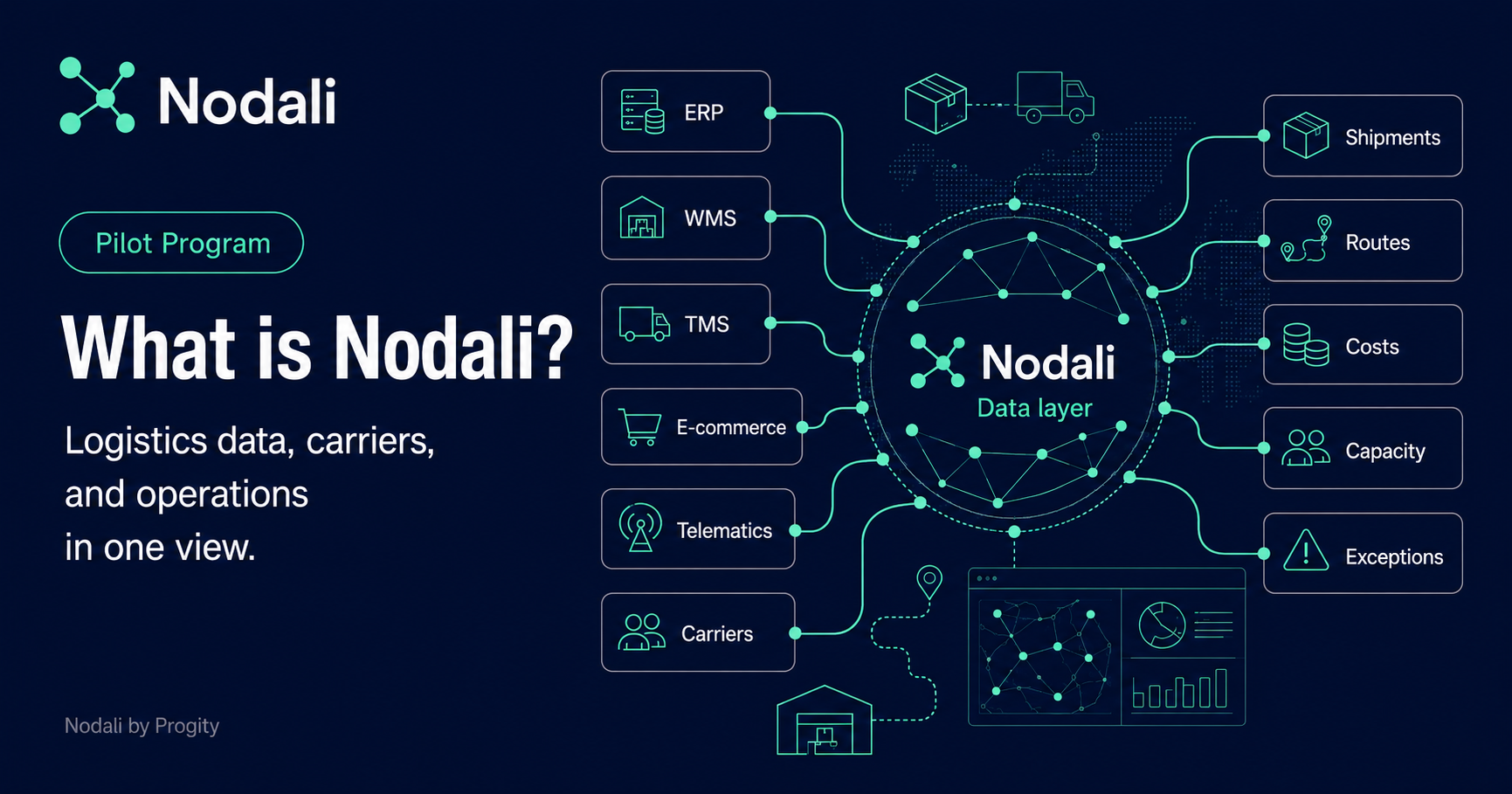
Companies today use an ever-growing number of systems. Orders originate in an e-commerce platform or ERP, warehouses operate through a WMS, transport is planned in a TMS, vehicle movements are monitored through telematics, and the actual costs often appear only later in accounting systems or carrier invoices.
Each of these systems may handle its own part of the process well. The problem arises when a company needs to answer a simple operational question:
What is actually happening in our logistics right now, and how much is it costing us?
The answer is often not available in a single system. It has to be assembled manually from multiple exports, spreadsheets, emails, carrier portals, and reports. The data may also be inconsistent, arrive at different times, and use different identifiers.
This is precisely the problem that Nodali is designed to solve.
Nodali is logistics data software that connects orders, shipments, carriers, routes, costs, capacities, and operational exceptions into a single shared view. It does not automatically replace ERP, WMS, or TMS systems. Instead, it creates a data and control layer above them, making logistics easier to monitor, evaluate, and gradually automate.
Nodali is currently under development, and we are looking for companies interested in participating in the first pilot implementations.
Why Nodali Is Being Built
Modern logistics usually does not suffer from a lack of data. It suffers because the data is spread across too many places.
A single company may use, for example:
- an e-commerce platform or customer portal for orders
- an ERP system for commercial and financial operations
- a WMS for warehouse management
- a TMS for transport planning
- telematics for vehicle location and movement
- a time and attendance system for shifts and working hours
- a CRM for customers and commercial relationships
- accounting software for invoicing and costs
- individual carrier portals
- Excel or Google Sheets for reporting and manual checks
Each system contains only part of the full story. An ERP system may know that an order was created. A WMS knows when it was prepared. The carrier knows how delivery progressed. Accounting later reveals the cost. None of these systems, however, necessarily provides the full operational context.
The result is often:
- manual merging of multiple exports
- different figures across individual reports
- late detection of delays or exceptions
- complex carrier performance comparisons
- difficult verification of invoiced prices
- unclear profitability of routes, depots, or customers
- decisions based on incomplete or outdated data
Nodali is being built so that operational data no longer has to be manually assembled from scratch every time.
What Exactly Does Nodali Do?
Nodali connects available data from existing systems and transforms it into a shared model.
It is not simply about displaying a few charts. The core objective is to create a data layer in which information about orders, shipments, carriers, routes, customers, capacities, and costs can be connected securely and consistently.
Nodali is built around three core principles:
1. Connect: Connect the Data
The first step is connecting existing data sources. Depending on the capabilities of a particular system, this may include:
- REST APIs
- webhooks
- SFTP
- SQL databases
- CSV or XLSX exports
- regularly delivered reports
- spreadsheet-based feeds
- a custom-built connector
There is therefore no need to wait until every internal system has been modernized or equipped with an ideal API. A pilot can be designed around the data the company actually has available.
2. Understand: Understand the Operation
Simply connecting systems does not create value on its own. The data must be standardized, validated, and placed in the correct context.
Based on connected data, Nodali can create, for example:
- a unified overview of orders and shipments
- the performance and reliability of individual carriers
- planned-versus-actual comparisons
- capacity utilization
- operational KPIs
- an overview of delayed, returned, or at-risk shipments
- costs by route, depot, region, or customer
- supporting data for verifying carrier and partner invoices
3. Act: Respond and Automate
The long-term objective is not merely to review the past in reports. Nodali is intended to enable companies to work with exceptions, alerts, and follow-up workflows based on unified data.
Examples include situations where:
- a shipment exceeds its expected delivery time
- a carrier repeatedly fails to meet the agreed SLA
- the actual distance significantly exceeds the plan
- depot or route capacity approaches its limit
- the invoiced price does not match the ordered service
- an expected status or document is missing for a shipment
Instead of manually searching for a problem across several systems, a specific exception can be created with an assigned owner, a resolution history, and a follow-up action.
Nodali Does Not Replace ERP, WMS, or TMS Systems
One of Nodali’s most important characteristics is that it does not force companies to immediately replace the systems they already use.
An ERP system can continue managing orders and financial operations. A WMS can continue managing the warehouse. A TMS can continue planning transport. An accounting system can continue processing invoices.
Nodali connects to the available data and creates a shared layer above these systems.
This approach is particularly suitable where:
- individual systems work, but are not well connected
- replacing the main ERP or WMS would be too risky
- the company uses proprietary or historically developed systems
- part of the operation still depends on exports and spreadsheets
- the company needs visibility sooner than a multi-year transformation could provide
The goal is not to add another isolated application. The goal is to create a shared operational picture across everything the company uses today.
Who Is Nodali Designed For?
Nodali is primarily being built for two main types of logistics operations.
E-commerce Companies Using External Carriers
An e-commerce company usually has good visibility of an order until it is dispatched. The next part of the process is distributed across the portals and data sources of individual carriers.
Nodali can help e-commerce companies monitor, for example:
- shipment status across multiple carriers
- delivery speed
- the number of delayed or stalled shipments
- first-attempt delivery success rate
- returns and undelivered shipments
- carrier performance by region or service
- transportation costs
- supporting data for invoice verification
More information is available on the Nodali for E-commerce page.
Companies with Their Own or Hybrid Logistics
With in-house logistics, the situation is often even more complex. Planned routes, actual vehicle movements, capacities, shifts, shipments, depots, and real costs all need to be connected.
Nodali can create views covering, for example:
- the current status of routes and depots
- planned and actual hours
- planned and actual distance
- capacity utilization
- delayed departures and arrivals
- deviations from planned routes
- costs for a specific route or customer
- the performance of in-house couriers and external partners
More information is available on the Nodali for In-house Logistics page.
What Modules Does Nodali Include?
Nodali is designed as a modular platform. A company does not have to start with everything at once. A pilot can address one specific problem, with additional components added gradually if needed.
Nodali Connect
Data connections, imports, synchronization, mapping, and validation between individual systems.
Nodali Carriers
An overview of external carrier performance, shipment tracking, delays, returns, delivery speed, and transport service comparisons.
Nodali Insights
Operational KPIs, planned versus actual performance, productivity, capacity, depot performance, and custom dashboards.
Nodali Control
The current operational status of shipments, routes, warehouses, depots, capacities, and related risks.
Nodali Finance
Actual costs, profitability of routes, depots, regions, or customers, and supporting data for carrier and partner settlement.
Nodali Exceptions
Operational exception records, assignment of responsibility, SLA monitoring, resolution history, root causes, and automated alerts.
Nodali Routes
Route verification, comparison of planned and actual route execution, and retrospective evaluation of deviations using map data.
The individual modules are at different stages of development. The specific scope of a pilot is therefore always based on the participating company’s problem, data, and priorities.
What Does a Pilot Implementation Look Like?
Nodali is not designed as another universal SaaS platform where a company signs up, enters a payment card number, and expects all of its systems to connect automatically.
Logistics processes and data sources vary significantly between companies. A pilot therefore begins with understanding the specific operation.
A typical pilot implementation consists of four parts:
1. Process and Data Analysis
First, we review the current logistics process, the systems in use, the available data, and the questions the company cannot currently answer easily.
This may include, for example:
- carrier performance
- cost per shipment
- route profitability
- operational capacity
- invoice verification
- delayed shipments
- manual operational reports
2. Connecting the Available Sources
We select the data required for the pilot and design a suitable method for transferring it. This does not have to be limited to APIs. Depending on the situation, the pilot can also begin with an export, database access, SFTP, or a regularly delivered data file.
3. Configuring the Data Model and Dashboards
The data is standardized, validated, and transformed into a shared model. Specific dashboards, metrics, roles, and any required alerts are then created.
4. Pilot Operation and Further Development
The result is validated using real data. We verify the quality of the connections, the accuracy of the metrics, and whether the dashboards genuinely support everyday operations.
Additional modules are introduced only based on proven value and priorities.
Why We Are Looking for Pilot Partners
Nodali is currently in the development stage of the first version of the platform. The data layer and integrations are being built first, followed by operational analytics and additional modules.
We do not want to create a generic dashboard based solely on assumptions. We want to build the platform around the problems logistics teams actually face.
A pilot partner can help shape, for example:
- the priorities of the first modules
- the structure of the logistics data model
- the most important operational metrics
- required integrations
- the way exceptions are handled
- the design of dashboards and reports
- the automations that provide the greatest operational value
A pilot is not a commitment to replace the entire infrastructure. It can begin with one specific use case, one data source, or one part of the operation.
What Kind of Company Is Suitable for a Pilot?
The most important factor is not the size of the company or the number of systems it uses. What matters is the existence of a specific logistics or data problem that can be validated together.
A suitable pilot partner may be a company that:
- uses multiple external carriers
- operates in-house or hybrid logistics
- has multiple depots, warehouses, or sites
- prepares operational reports manually
- merges data in Excel or Google Sheets
- finds it difficult to evaluate carrier performance
- lacks a clear view of actual logistics costs
- manually checks carrier and partner invoices
- only addresses delays after a customer reports them
- needs to connect proprietary or older internal systems
The data does not need to be perfectly prepared. Its availability, quality, and structure are themselves part of the initial analysis.
What Does a Pilot Partner Gain?
The exact scope is defined individually, but the aim of the pilot is to create a practically usable result based on real operations.
A pilot partnership may provide:
- an analysis of current data and operational flows
- a proposal for a shared logistics data model
- connections to selected systems or exports
- a unified overview of a specific part of logistics
- validation of data quality and usability
- specific KPIs and operational reports
- the opportunity to influence the product direction
- a foundation for further automation and expansion
The scope, timeline, and price of a pilot depend on data availability, integration complexity, and the selected use case. Pilot and custom implementations are therefore handled individually.
How to Apply for the Pilot Program
Applying is non-binding.
Simply complete the short form on the Nodali website and provide:
- your name
- your company
- your work email address
- optionally, your phone number
- the number of sites or depots
- the systems you currently use
- a brief description of your logistics or data problem
After submission, we will contact you and review your operation, current systems, and whether a Nodali pilot is a suitable fit.
There is no need to prepare an extensive specification. For the first conversation, it is enough to describe what you currently handle manually, where you lack visibility, or which part of logistics you would like to measure more effectively.
What Nodali Is Not
Explaining what Nodali should not be expected to do is just as important as explaining what it does.
Nodali is not:
- a ready-made replacement for any ERP, WMS, or TMS
- a universal dashboard disconnected from your processes
- merely a charting tool
- a solution that automatically fixes poor-quality input data
- an off-the-shelf application with identical settings for every company
- a promise that every module is already complete
Nodali is an emerging modular platform. It begins by connecting data, creating a consistent operational view, and validating specific value in a pilot operation.
Experience from Real Logistics Operations
Nodali is not being built solely as a technology experiment.
The project is based on more than ten years of experience in e-commerce logistics, dispatch operations, process management, implementing logistics processes in international markets, and developing business software.
This means we do not view logistics merely as a collection of APIs and database tables.
The technical solution must also respect:
- the real work of dispatchers and operational teams
- time pressure during a shift
- exceptions that cannot be resolved through a standard process
- differences between plan and reality
- responsibility for specific operational decisions
- the need for traceability and history
- the financial impact of operational deviations
The goal is to build a tool for real operations, not merely an attractive presentation based on sample data.
What Comes Next?
Nodali will be developed gradually.
The first stages will focus on:
- the data layer
- integrations and imports
- unification of logistics entities
- operational analytics
- external carrier performance
These stages will be followed by areas related to costs, profitability, operational exceptions, workflows, and assisted data evaluation.
The roadmap is intentionally directional and does not assign fixed dates to every module. Priorities will also be influenced by experience from the first implementations.
Frequently Asked Questions
What exactly does Nodali do?
Nodali connects data from ERP, WMS, TMS, e-commerce platforms, telematics, accounting systems, carriers, and other sources into one consistent view of logistics operations, performance, costs, and exceptions.
Do we need to replace our ERP, WMS, or TMS because of Nodali?
No. Nodali is designed as a data and control layer above the systems you already use. Depending on data availability, it can connect through APIs, SFTP, databases, exports, or custom integrations.
Is Nodali already available?
Nodali is currently under development. We are preparing the first version of the data layer, integrations, and operational analytics, and we are looking for companies interested in a pilot implementation.
Who is the pilot suitable for?
Primarily e-commerce companies using external carriers and companies with in-house or hybrid logistics. It is also suitable for companies with multiple depots, fragmented data, manual reporting, or logistics costs that are difficult to trace.
Do we need to have an API ready?
No. Integration options are assessed individually. Depending on the situation, we can also work with database access, SFTP, CSV or XLSX exports, regular reports, or another secure method of data transfer.
How much does a Nodali pilot cost?
The price depends on the scope, data availability, the number of connected sources, and the complexity of the required integrations. Pilot and custom implementations are therefore priced according to the specific situation.
Is applying for the pilot binding?
No. By submitting the form, you are only expressing interest. We will then review your operation together and assess whether there is a suitable pilot use case.
Can we start with just one carrier or one part of the operation?
Yes. A pilot should be limited to a specific problem, data source, carrier, depot, or part of the process. Additional areas can be added gradually based on the results.
Who is behind Nodali?
Nodali is being developed under the Progity brand and is based on experience in e-commerce logistics, process management, dispatch operations, data integrations, and custom software development.
Would You Like Better Visibility into Your Logistics?
We are looking for companies that want to connect their logistics data more effectively and solve a specific operational problem.
A pilot can begin with topics such as:
- carrier performance and reliability
- shipment tracking across multiple carriers
- delayed and returned shipments
- transportation cost verification
- planned-versus-actual comparisons
- capacity utilization
- route or depot profitability
- connecting data from ERP, WMS, TMS, and telematics
- replacing a manually assembled report
Briefly describe your operation, the systems you use, and the problem you currently handle manually.
Nodali | Nodali for E-commerce | Nodali for In-house Logistics | Pricing | Pilot Program